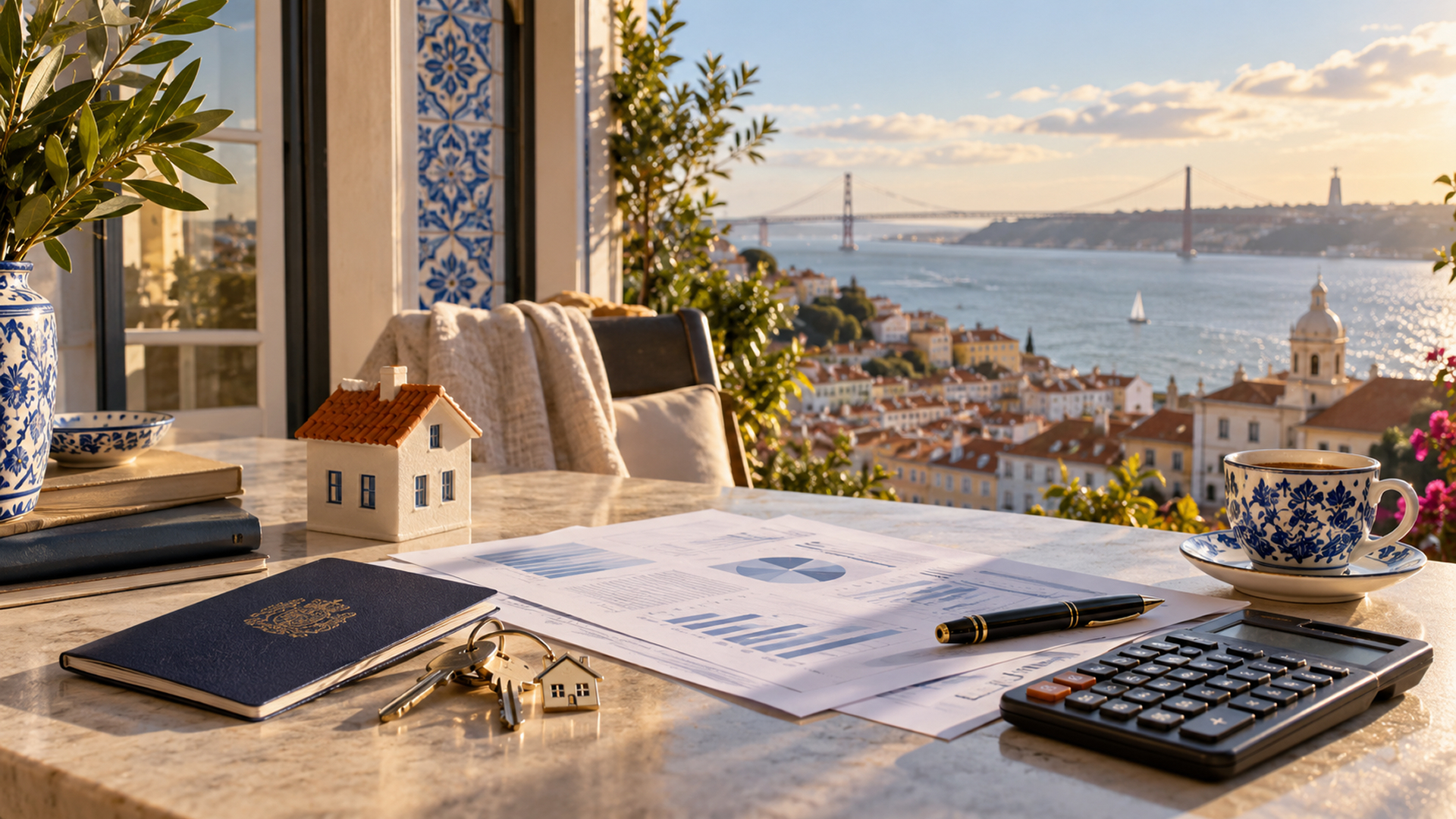
Buying a finished home means walking through rooms that already exist, looking out of the actual windows and checking the condition of the building. Buying off-plan is different: some of the most important decisions have to be made while the property still exists mainly as plans, specifications and a construction schedule.
For a buyer in Portugal, this means looking not only at the future home but also at the developer, the project documentation, the contract, the payment schedule and the way changes or delays will be handled.
What Is Off-Plan Property?
An off-plan property is bought before construction is fully completed and, in some developments, before substantial building work has started.
Instead of inspecting a finished apartment, the buyer may be choosing from floor plans, architectural drawings, computer-generated images and a specification describing materials, equipment and common areas.
Imagine two apartments with almost identical layouts. One faces a quieter courtyard, while another faces the street. One has a larger terrace, while the other has better afternoon light. Those differences may be obvious on the plans but impossible to experience physically when the building does not yet exist.
This is why the exact unit matters from the beginning. Floor, orientation, internal area, balcony or terrace and its position within the development should all be clear before the buyer commits to the purchase.
Why Buy Off-Plan?
One of the clearest advantages of buying early is choice. At the beginning of a development, several units with the same number of bedrooms may still be available, giving the buyer more freedom to compare floors, orientation, outdoor space and position within the building.
That choice can narrow as sales progress. Someone who waits may find that the preferred layout is still available, but only on a lower floor or with a different orientation.
Some developments in Portugal also allow buyers to choose between selected finishes, kitchen options or other details before construction reaches a certain stage. The possibilities depend on the individual project, so any customization that matters should be confirmed before the relevant work is completed.
New-build property can also provide newer insulation, building systems, windows and equipment without requiring the renovation that an older home might need. The actual specification remains more important than the simple fact that a development is new.
The value of the property may also change between the initial agreement and completion. An increase is possible, but it should never be treated as a guaranteed part of the purchase.
For someone comparing Portugal real estate, buying off-plan is therefore not simply a search for a lower entry price. It can also be a way to choose more precisely while a larger part of the development is still available.
Check the Developer and Project
A polished showroom tells the buyer how a development is intended to look. Previous completed projects provide much better evidence of how a developer actually delivers.
Look for developments that the company has already finished in Portugal and that are now occupied. If possible, compare the completed result with the original promotional material. Façades, landscaping, entrances and common areas can reveal more than photographs taken immediately after construction.
It is also worth establishing who is actually involved in the development. The company marketing the units may be different from the construction contractor, and the commercial brand may not be the legal entity responsible for the project.
Useful questions include:
- Which company is promoting or developing the project?
- Who is the construction contractor?
- Which residential projects have already been completed in Portugal?
- Were earlier developments delivered with significant delays?
- Are there completed buildings that can be visited?
- Does the developer have several major projects under construction at the same time?
- Are recurring complaints visible in previously completed developments?
Then turn to the project itself.
In Portugal, property and land-registry records can help establish the legal position of the development. At an early construction stage, the available information may relate to the land or development rather than to an individual completed apartment, so it is important to understand what is currently registered and how the unit being sold is identified in the project documentation.
Confirm the relevant planning and construction documentation and identify the exact unit being purchased. Compare the documentation with the characteristics that actually influenced the decision: internal area, orientation, terrace or balcony, floor, ancillary spaces and common facilities.
The same principle applies to features promoted as part of the development. If a rooftop pool, landscaped garden or residents’ gym is important to the purchase, check how that feature appears in the project documentation instead of relying only on a render.
The buyer should also establish exactly what is included in the agreed price. Parking, storage or other spaces should be clearly identifiable rather than assumed to accompany the apartment automatically.
Reservation and CPCV
A reservation can temporarily remove a unit from the market while the parties prepare the next stage of the transaction. Its conditions vary, so the reservation document should be read before any money is transferred.
Check what the payment is for, whether it is refundable and what happens if the Contrato-Promessa de Compra e Venda (CPCV) is not ultimately signed. A short reservation form can still contain conditions with financial consequences.
The CPCV is the Portuguese promissory purchase and sale agreement. It is not compulsory in every Portuguese property transaction, but it is particularly important when buying off-plan because the buyer may commit to the purchase long before the apartment is completed.
For an off-plan property, particular attention should be given to:
- identification of the exact unit;
- purchase price and payment method;
- amounts already paid;
- future payment schedule;
- expected completion and final purchase dates;
- any contractual grace period;
- consequences of non-performance;
- plans and specifications attached to the agreement;
- agreed ancillary spaces;
- permitted changes to the project;
- conditions for terminating the agreement.
Portuguese law also establishes formal requirements for promissory contracts involving buildings or autonomous units that are already built, under construction or still to be built. This is one reason the CPCV for an off-plan purchase should be reviewed as a legal agreement rather than treated as another sales document.
The sinal deserves particular attention as well. In Portuguese property transactions, this is not simply another instalment. Under the Portuguese Civil Code, money delivered by the prospective buyer to the prospective seller under a purchase-and-sale CPCV is presumed to have the character of a sinal even if it is described as an advance or part-payment.
Its consequences can be significant. Where non-performance is attributable to the party who provided the sinal, the other party may be entitled to retain it; where the party who received it is responsible, the other party may in certain circumstances claim twice the amount paid. The exact consequences depend on the agreement and circumstances, so this is not a clause to treat as routine.
The annexes deserve as much attention as the main pages. Floor plans, finish schedules, equipment lists and drawings can contain some of the most important information about what will ultimately be delivered.
A useful rule is simple: if a feature materially influenced the decision to buy, find where it is described in the contractual documentation.
Foreign buyers also need a Portuguese NIF — Número de Identificação Fiscal, or tax identification number, for the tax obligations connected with buying property in Portugal.
Payments During Construction
An off-plan transaction can require several payments before the final purchase. The number, timing and size of those payments depend on the individual development and CPCV.
Before signing, make a simple payment calendar. Record each payment, what triggers it and where the money will come from.
Where an instalment is linked to construction progress, the relevant stage should be understandable. A payment connected to a clearly identifiable construction milestone gives the buyer more information than a vague reference to progress on site.
Financing also needs to be considered early. A preliminary discussion with a bank does not guarantee that exactly the same mortgage amount or conditions will be available when construction finishes.
Suppose the buyer expects a mortgage to cover the final balance, but the completed property receives a lower bank valuation or the lender approves a smaller loan. The difference may have to be covered with the buyer’s own funds.
That leads to one useful question before signing the CPCV:
If the bank provides less financing than expected, can I still complete the purchase?
For a project that may take considerable time to finish, that question can be more important than the monthly mortgage estimate available at the beginning.
Changes During Construction
Some technical adjustments during construction are possible even in well-planned developments. The important issue is the extent of the developer’s contractual ability to make them.
Specifications may state that a particular material or product can be replaced with an “equivalent” alternative. That word can cover a surprisingly wide range of outcomes.
If a specified floor, sanitary fitting or appliance becomes unavailable, for example, what qualifies as equivalent? Similar appearance, technical performance, quality and price are not necessarily the same thing.
Minor substitutions are also different from changes that alter how the property is used. Moving an internal wall, changing the dimensions of a terrace or materially altering a common facility can have a much greater impact than changing one appliance model.
Keep copies of the plans, specifications, brochures and relevant written communication received during the purchase process. If an important feature is changed or a new solution is agreed, confirm the final arrangement in writing.
This is particularly useful for foreign buyers who are following construction in Portugal from abroad and cannot visit the site regularly. A clear paper trail makes it easier to see which version of a plan or specification is current.
Completion and Final Purchase
As construction approaches completion, the relationship with the property changes. For the first time, the buyer can compare the physical result with the agreed plans and specification.
The pre-completion visit should therefore be treated as an inspection rather than a normal viewing.
Take the floor plan and specification with you and work through the property methodically. Useful checks include:
- opening and closing windows and doors;
- running water and checking drainage;
- testing switches and electrical outlets;
- checking air-conditioning or heating equipment;
- inspecting kitchen units and installed appliances;
- looking for cracks or unfinished surfaces;
- checking for signs of moisture around windows, bathrooms and exterior walls;
- inspecting balcony or terrace finishes and drainage;
- comparing flooring and other finishes with the specification;
- checking the agreed ancillary areas;
- confirming that the layout corresponds to the plan.
Take photographs of anything that needs attention. A photograph accompanied by the room and exact location is much more useful than a general note that “the wall needs fixing.”
Defects and incomplete work can be recorded in a snag list. Where problems are identified, the buyer should obtain a clear written record of what has been reported and how the outstanding items will be handled.
A professional technical inspection can also be worthwhile. Cosmetic defects are relatively easy to spot, while waterproofing, drainage, ventilation and installation problems may be less obvious to someone without construction experience.
Before the final purchase in Portugal, the documentation for the completed property also needs to be checked. Relevant documents can include land-registry information, tax records, documents required for the use of the property, the energy certificate and other documentation applicable to the particular transaction.
The acquisition generally involves IMT — Imposto Municipal sobre as Transmissões Onerosas de Imóveis — and Imposto do Selo, or Stamp Duty, unless an applicable exemption applies.
Procedures connected with the final purchase and registration can also be handled through Casa Pronta, Portugal’s one-stop service for property transactions and registration.
Getting the keys does not necessarily mean that every problem has already become visible. Where a new property is sold by a professional to a consumer, Portuguese consumer law provides liability periods of 10 years for lack of conformity involving structural construction elements and five years for other lack of conformity.
For that reason, keep the CPCV, final specifications, photographs, inspection records and important correspondence after completion.
Off-Plan Buying Risks
The risks of an off-plan purchase are easiest to understand through their practical consequences.
A late completion may leave a buyer paying rent for longer than expected or force a change in plans to move to Portugal. For an investor, it can postpone the point at which the property can begin generating income.
Changes to the development can affect more than appearance. A different layout, altered outdoor space or modification to a common facility can change how attractive or useful the property is.
Construction defects can also occur in a new building. Problems with finishing, water ingress, drainage, windows or installed equipment may only become visible during inspection or after the building starts being used.
Developer financial difficulties carry a different level of risk because part of the purchase price may already have been committed while the development remains unfinished.
There is also financing risk. A long period between CPCV and completion creates time for the buyer’s circumstances, property valuation or lending conditions to change.
Finally, renders can create expectations that physical buildings cannot reproduce exactly. Ideal lighting, mature landscaping and carefully chosen perspectives should not be confused with measurable characteristics such as dimensions, orientation and the actual position of the unit.
Conclusion
When buying property off-plan in Portugal, the most important decisions are made long before the keys are handed over. The more clearly the property, transaction terms, payments and permitted changes are defined in advance, the less uncertainty remains at completion.
The buyer’s goal is not to predict every possible risk, but to check and document everything that can be clarified before making substantial financial commitments.