Buying in Portugal usually starts with the fun part: finding the right place. The harder part comes next. Once a buyer settles on a home, everything changes — a casual viewing turns into something legally and financially binding, and that's where mistakes get expensive.
This is exactly the point where understanding the Portuguese system pays off. Buyers who know what's coming avoid the kind of problems that are nearly impossible to undo once the process is underway.
Can Foreigners Buy Property in Portugal?
Short answer: yes, and nationality has nothing to do with it. There's no rule barring foreigners from owning a flat, a house or land in Portugal simply because they aren't Portuguese citizens.
Tax residency is a different story, though — it's what actually determines how a purchase gets taxed, not where the buyer's passport comes from. Sorting out tax status early saves guesswork later.
One more distinction worth making: buying a home doesn't hand you the right to live in Portugal permanently. Ownership and immigration are two unrelated systems. Anyone planning to eventually relocate needs to handle the purchase and the residence application as separate matters, even if they're pursuing both at once.
How to Buy Property in Portugal
Every Portuguese property purchase follows roughly the same shape, though the fine print — timing, financing, what buyer and seller actually agree to — always differs case by case.
Documents You Need
A NIF — Número de Identificação Fiscal, Portugal's tax ID number — is one of the first things a buyer needs. Anyone can get one, resident or not, and it is required for the purchase and many of the related tax and financial formalities.
Identification is the other non-negotiable. After that, the paper trail grows depending on the situation: marital status, a power of attorney if someone's buying on another's behalf, a mortgage if financing is involved.
A local bank account isn't strictly mandatory, but it makes payments far simpler, and banks financing the purchase will usually expect one anyway. Exact requirements differ by bank and by deal, so it's worth confirming rather than guessing from a generic list.
Property Checks Before Signing
The building is half the story. What's recorded about it legally is the other half — and arguably the more important one.
Start with the certidão permanente predial. This permanent land registry certificate lays out who owns the property, what charges are registered against it, and whether any registration requests are still pending.
Then there's the caderneta predial, the property's tax record — it covers identification details, physical characteristics, and the Valor Patrimonial Tributário (VPT), which is the value the tax authorities assign to the property.
Some properties bring more checks into the mix: whether the property's use is duly authorised, its energy certificate, and relevant technical information.
Apartments add another layer — condominium records, where the real risk sits in unpaid charges, upcoming works, and ongoing obligations nobody mentioned upfront.
Buyers looking at older houses, renovated properties or rural land shouldn't take anything for granted. A converted attic, an added extension or an outbuilding should be checked against the applicable planning, registry and tax records rather than accepted at face value.
Steps of the Purchase Process
Deals don't always follow this exactly, but most move through the same broad stages:
- First, buyer and seller lock in the essentials: which property, what price, roughly what timeline.
- Next comes due diligence — checking ownership, registration, documentation, and any obligations tied to the property.
- If a CPCV is used, it gets signed at this point — the Contrato-Promessa de Compra e Venda spells out the deal's terms, deadlines, and the fallout if either side walks away.
- Financing gets locked in — a mortgage, if there is one, is finalised alongside whatever paperwork completion requires.
- The taxes come due before completion can happen — IMT and Stamp Duty need to be paid (or an exemption confirmed) before the deal can close.
- The sale itself gets formalised, via deed or authenticated private document.
- Finally, the registry gets updated so the new owner is officially on record.
Casa Pronta exists to make this easier — it's a Portuguese service that bundles several of these steps (purchase, mortgage, registration) into one process.
Mortgage in Portugal for Foreigners
Non-residency is no obstacle to getting a mortgage from a Portuguese bank. What matters instead is the individual file: how much the applicant earns, their line of work or business, any debts already on the books, where they pay tax, their age, the currency their pay arrives in, and — just as importantly — a valuation of the property itself.
None of that comes with fixed terms, either. Two residents can get different offers from two banks, and a non-resident's numbers might look different again. Before signing up for anything credit-dependent, three questions are worth answering first: how much will actually get financed, what paperwork will be asked for, and how affordability will be judged.
Currency is the wildcard most people forget about. A euro-denominated mortgage paid off with income earned in pounds, dollars or anything else means the exchange rate is quietly doing its own math on affordability, year after year.
Property Taxes in Portugal for Foreign Buyers
Buying the property is only the first tax event — ownership keeps generating them for as long as the property belongs to someone.
Two show up right at completion. One is IMT, short for Imposto Municipal sobre as Transmissões Onerosas de Imóveis — Portugal's tax on transferring property. The other is Stamp Duty, or Imposto do Selo. Whichever figure is larger, the contract price or the property's official VPT, is what IMT gets worked out against.
For non-residents specifically, buying residential property triggers its own IMT rules. As things stand, a flat 7.5% applies to urban housing bought by someone who isn't a tax resident — with a handful of legal exceptions carving out different treatment.
Two situations tend to unlock those exceptions: becoming a Portuguese tax resident somewhere down the line after the purchase, or entering into certain qualifying rental agreements. Given how much turns on the buyer's specific situation, figuring out tax status ahead of time beats trying to work backward from an assumption.
Then there's Stamp Duty itself — a flat 0.8% on the taxable value of the transfer, with an extra charge layered on top if a mortgage is part of the picture.
Ownership doesn't end the tax story either. Each year brings IMI (Imposto Municipal sobre Imóveis), worked out from the VPT at a rate the local municipality sets within limits defined by law. Higher-value properties can also attract AIMI (Adicional ao IMI), an extra layer that kicks in based on taxable value and how the property is held.
What all this adds up to isn't fixed — residence status, the property itself and its intended use all bend the final number. A tax breakdown that fits one foreign buyer perfectly might not fit the next one at all.
Where to Buy Property in Portugal
"Best" isn't really a fixed spot on the map here — it moves depending on what someone actually needs: full-time living, the flexibility to work remotely, international schools within reach, frequent trips abroad, or a place that only gets used part of the year.
A region's name and reputation matter less, in practice, than the everyday life a property has to carry — getting around, seeing a doctor, schooling, the weather, how much can be reached on foot, and how demanding the upkeep turns out to be. Those are the details that tend to outlast the initial appeal of a place. When comparing Portugal real estate, these practical differences are worth considering alongside the property itself.
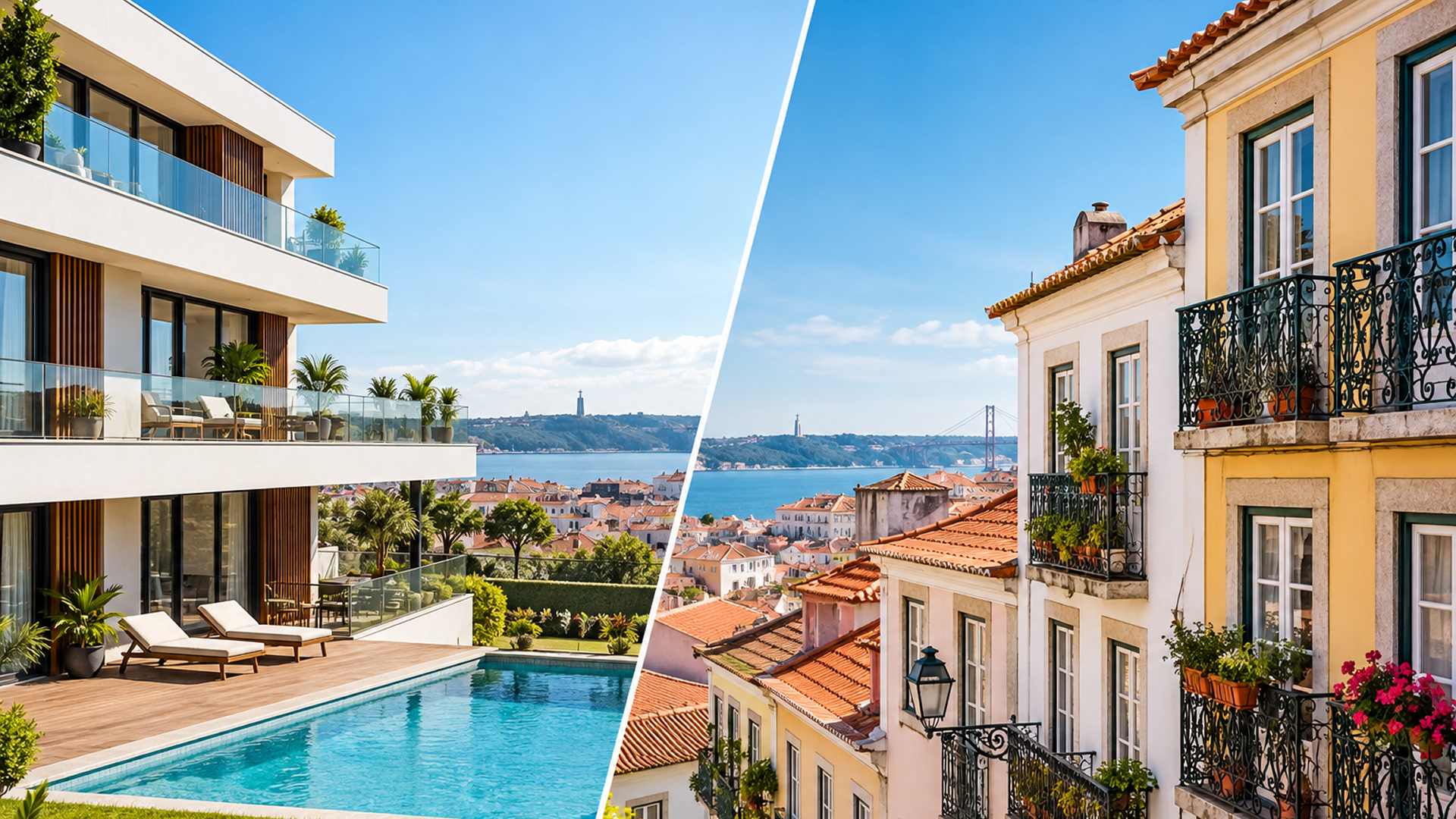
Housing choices swing just as widely: a flat in the middle of a city, a villa near the water, an old house tucked into a village, a quinta with its own land — each one hands the owner a completely different kind of responsibility.
| Location Type | May Suit | Practical Point to Consider |
|---|---|---|
| Lisbon area and Cascais | Best for buyers who value international connections, career options, schools and city services | Urban density here means the specific neighbourhood matters more than the city name alone |
| Porto, Braga and northern cities | Good fit for established city infrastructure with easy access across the north | Expect wetter winters, and check older housing stock carefully |
| Algarve | Suits buyers chasing coastal life, outdoor space or seasonal living | Tourism levels and seasonal buzz differ sharply from town to town |
| Silver Coast and central Portugal | For those wanting Atlantic proximity with a mix of towns and quieter, less dense areas | Services and transport can thin out fast once you're past the main centres |
| Douro and inland areas | Fits buyers after rural space, village life or agricultural land | Expect land, utilities and general upkeep to demand far more hands-on involvement than a city flat ever would |
What Happens After Buying Property in Portugal?
First order of business after completion: confirm the registry actually reflects the change of ownership correctly.
What comes after that depends entirely on the property, but the usual checklist includes:
- getting electricity, water, gas and telecoms connected or transferred;
- setting up property insurance, including whatever a mortgage lender demands;
- figuring out condominium payments, rules and any works planned, if the property's part of a shared building;
- keeping tax records and contact details current;
- budgeting for IMI every year, plus whatever else applies;
- staying on top of maintenance — gardens, pools, rural land, older structures, whatever the property needs.
Settling in full-time brings its own bit of paperwork — namely, getting the address on record updated for immigration, tax and other official matters. Second-home owners are looking at a completely different set of concerns, especially once the place sits empty for weeks or months on end.
Long stretches away from Portugal call for a plan — someone lined up in advance to deal with maintenance, emergencies, condominium issues, or whatever else won't wait until the owner is back.
Conclusion
A property purchase in Portugal isn't judged by how smoothly the closing goes. It's judged later — by whether the legal situation, taxes, financing and upkeep stay manageable, and whether the property still does what it was bought to do.
There's no shortage of property types and locations to pick from as a foreign buyer. What separates a good choice from a great one is simple: does it still work in everyday life, long after the paperwork's been signed.